Neuroplasticity Explained: How Your Brain Rewires Itself
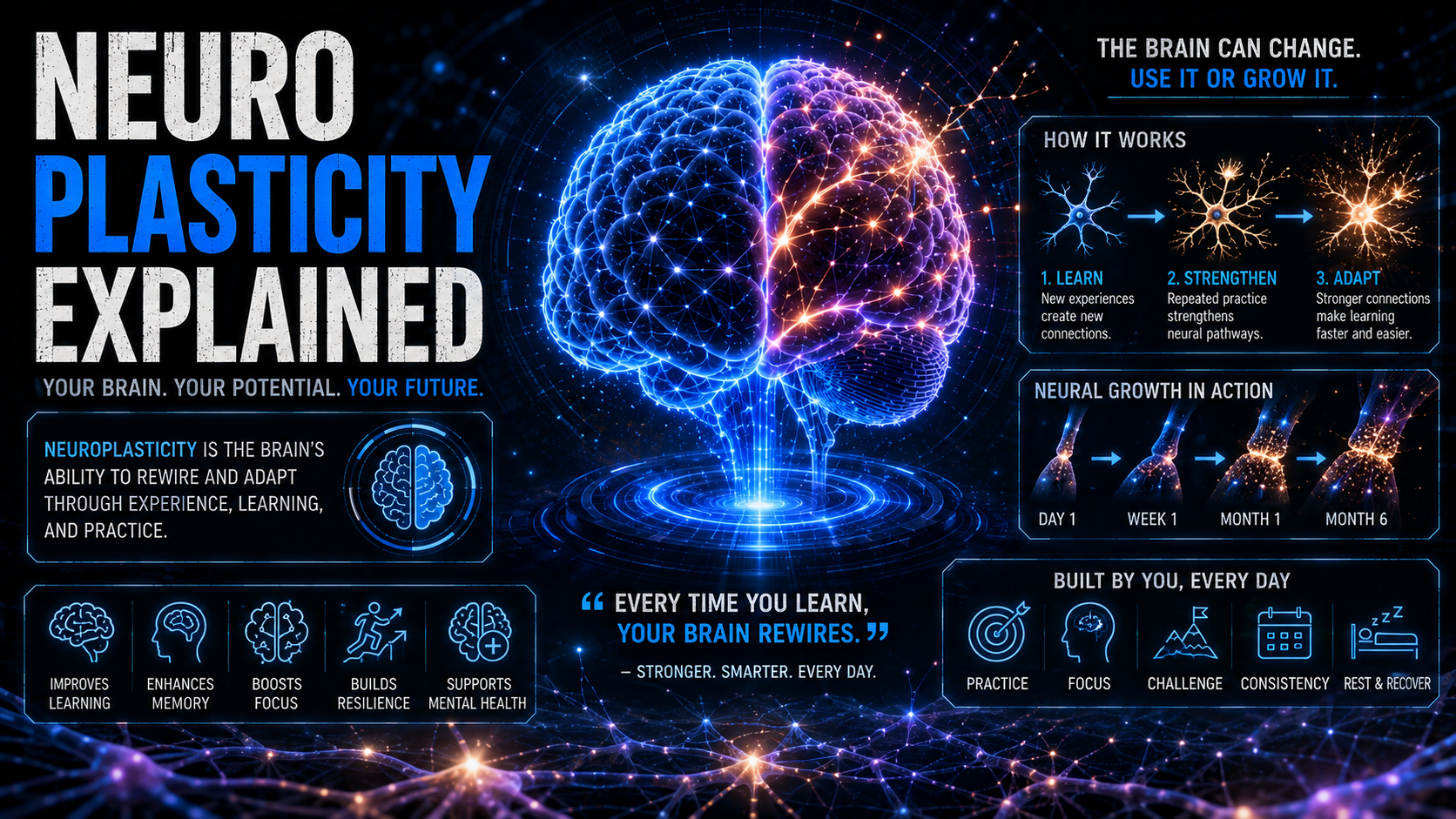
Discover what neuroplasticity is, how the brain creates new neural connections, and science-backed ways to strengthen learning, memory, and cognitive performance.
Introduction
For many years scientists believed that the human brain became fixed after childhood. Once brain development was complete, it was thought that the brain could no longer change significantly. Modern neuroscience has completely changed that belief.
Today we know the brain constantly adapts throughout life. Every new skill you learn, every language you study, every habit you build, and every challenge you overcome changes the physical structure of your brain.
This remarkable ability is known as neuroplasticity.
What Is Neuroplasticity?
Neuroplasticity is the brain's ability to reorganize itself by creating, strengthening, weakening, and modifying neural connections.
Every experience changes the communication between billions of neurons. The more frequently a neural pathway is used, the stronger it becomes.
Why Neuroplasticity Matters
Without neuroplasticity, learning would not exist. Reading, writing, driving, speaking another language, solving puzzles, and remembering names all depend on the brain's ability to adapt.
Plasticity allows people to recover from injuries, develop new skills, and continue improving throughout life.
How Neurons Communicate
The human brain contains roughly eighty-six billion neurons.
Each neuron communicates with thousands of others through tiny connections called synapses.
Whenever you practice a skill, these connections become stronger and more efficient.
Building New Neural Pathways
Learning something new forces the brain to create new pathways.
Repeating that skill strengthens those pathways until they become faster and require less conscious effort.
This is why difficult tasks gradually become automatic with practice.
Examples of Neuroplasticity
Learning a musical instrument.
Studying a new language.
Recovering after a stroke.
Improving memory.
Developing faster reaction times.
Learning mathematics.
Improving athletic coordination.
Practicing programming.
Can Adults Still Change Their Brain?
Absolutely.
Although children generally learn faster, adults continue developing new neural pathways throughout life.
Research shows the brain remains adaptable well into old age when challenged regularly.
Habits That Increase Neuroplasticity
Learning new skills.
Reading books.
Regular exercise.
Quality sleep.
Meditation.
Solving logic puzzles.
Playing memory games.
Learning another language.
Practicing creativity.
Maintaining social interaction.
Exercise and Brain Growth
Aerobic exercise stimulates the release of Brain-Derived Neurotrophic Factor (BDNF), often called 'brain fertilizer.'
BDNF supports the survival of neurons and encourages the growth of new neural connections.
Sleep Strengthens Neural Connections
Sleep allows recently formed neural pathways to stabilize.
Without sufficient sleep, the brain struggles to consolidate learning into long-term memory.
How Stress Affects Plasticity
Short periods of stress may temporarily improve alertness.
Long-term stress, however, weakens learning ability, memory, and neuroplasticity by disrupting healthy brain function.
Technology and the Brain
The brain adapts to whatever activities are repeated most often.
Hours of endless scrolling train the brain differently than reading books, solving puzzles, or learning difficult concepts.
Your daily habits literally shape your brain.
Brain Training
IQ challenges, memory exercises, reaction tests, pattern recognition, and logic puzzles all stimulate different cognitive systems.
The greatest improvements occur when activities remain challenging rather than becoming repetitive.
Common Myths
One myth claims adults cannot learn efficiently. Neuroscience clearly shows otherwise.
Another myth says intelligence is completely fixed. While genetics matter, the brain continues adapting throughout life.
Daily Routine to Strengthen Neuroplasticity
Exercise for at least thirty minutes.
Read for twenty minutes.
Solve several logic puzzles.
Practice memory exercises.
Learn something completely new.
Limit unnecessary social media.
Sleep consistently.
Stay curious every day.
Conclusion
Neuroplasticity is one of the greatest discoveries in modern neuroscience because it proves that the brain is not fixed.
Every healthy habit, every challenge, and every new skill physically changes your brain over time.
If you consistently learn, exercise, solve problems, and care for your health, your brain will continue adapting for decades.
The best investment you can make is giving your brain reasons to grow every single day.
Frequently Asked Questions
What is considered a good IQ score?
An IQ score around 100 is considered average. Scores above average may indicate stronger reasoning abilities, while lower scores simply reflect different cognitive performance compared with the population average.
Can I increase my IQ?
While IQ tends to remain fairly stable, healthy habits, education, regular exercise, quality sleep, and continuous learning can improve cognitive performance and problem-solving ability.
Are online IQ tests accurate?
Most online IQ tests are designed for entertainment and practice. Only professionally administered IQ assessments can provide standardized results.
Does IQ determine success?
No. Success depends on many factors including discipline, education, experience, emotional intelligence, communication skills, and persistence.
Related Articles
What Is IQ? Complete Beginner's Guide
Learn what IQ means, how IQ tests work, average IQ scores, and common myths.
What Is Brain Rot? Causes, Symptoms, and Recovery Guide
Discover what brain rot really means, why it happens, how social media affects attention, and practical ways to improve your focus.
Ready to Challenge Yourself?
Take our free IQ test and discover your cognitive strengths.
Start IQ Test