Logic Puzzles Benefits: How Brain Teasers Improve Intelligence
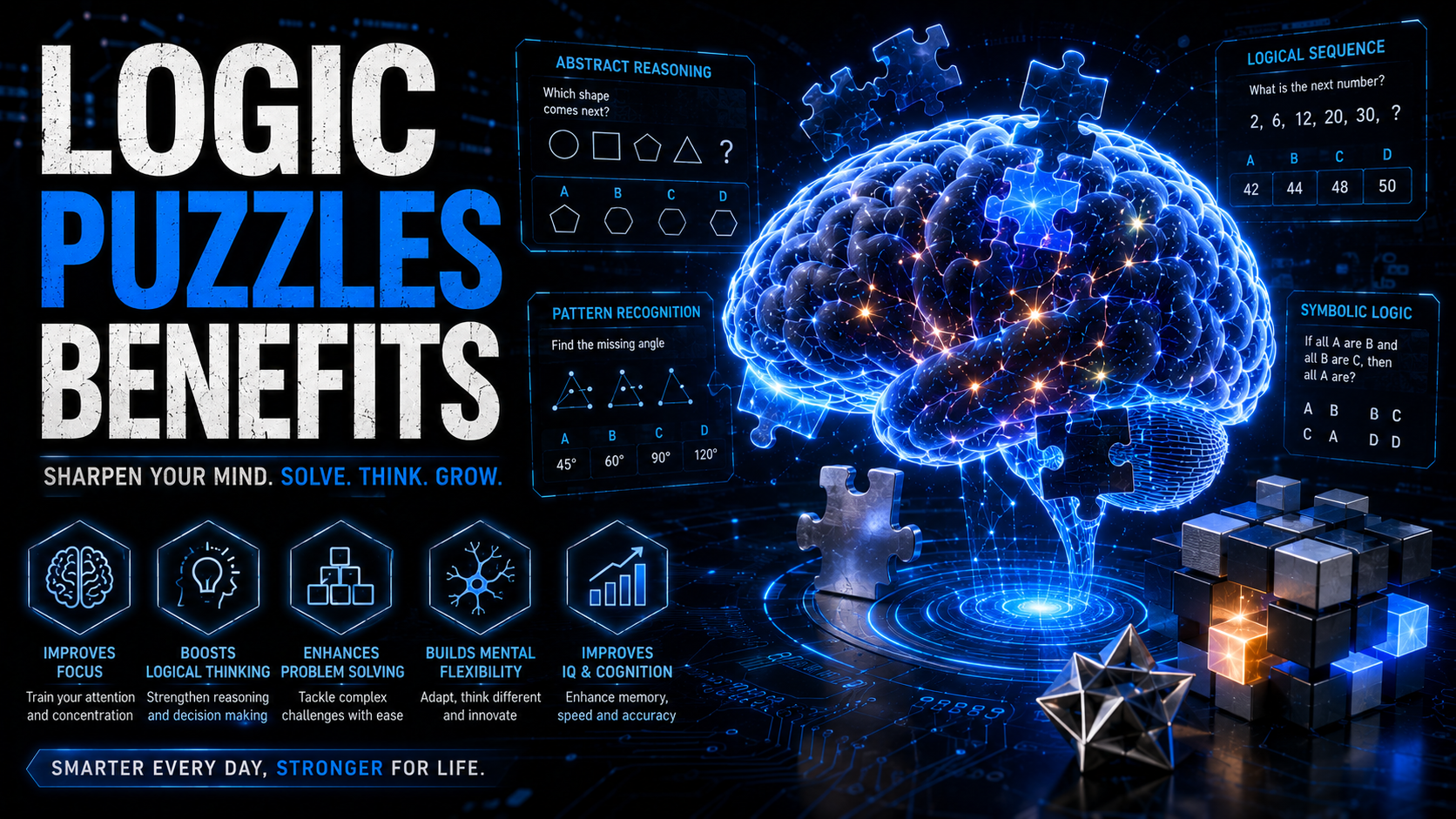
Discover how logic puzzles improve reasoning, memory, problem-solving, and overall brain performance according to scientific research.
Introduction
Logic puzzles are among the best exercises for improving cognitive performance. Unlike passive entertainment, puzzles require active thinking, reasoning, planning, and decision-making.
Millions of people solve Sudoku, chess problems, riddles, escape-room challenges, and pattern recognition puzzles every day because they are enjoyable while also strengthening important mental skills.
Scientific research suggests that regularly challenging the brain with difficult problems helps maintain cognitive performance throughout life.
What Are Logic Puzzles?
Logic puzzles are problems that require reasoning instead of memorization. The goal is to analyze information, identify patterns, eliminate impossible answers, and reach the correct solution.
Unlike trivia questions, logic puzzles reward thinking processes rather than previously learned facts.
How the Brain Solves Puzzles
When solving a puzzle, multiple brain regions become active simultaneously. The prefrontal cortex handles planning and reasoning, while memory systems store important clues and previous attempts.
The brain constantly compares possibilities until the most logical answer remains.
Improves Critical Thinking
Critical thinking involves evaluating evidence before making decisions. Logic puzzles teach the brain to avoid guessing and instead analyze information step by step.
This skill transfers into everyday decision-making, education, programming, engineering, business, and science.
Strengthens Problem-Solving Skills
Every puzzle presents a problem with limited information. Solving these problems repeatedly trains the brain to break large challenges into smaller manageable parts.
People who regularly solve puzzles often become more comfortable approaching unfamiliar situations.
Improves Memory
Many puzzles require remembering clues, previous moves, symbols, and patterns. This exercises working memory, one of the most important components of intelligence.
Better working memory supports learning, reading comprehension, mathematics, and reasoning.
Enhances Pattern Recognition
Pattern recognition allows people to identify relationships between objects, numbers, symbols, and events.
Logic puzzles constantly challenge this ability, making it easier to detect structures and hidden connections.
Increases Concentration
Unlike social media, puzzles demand sustained attention.
The longer you remain focused on solving difficult problems, the stronger your concentration becomes over time.
Boosts Processing Speed
As experience grows, the brain becomes faster at recognizing common strategies and eliminating impossible answers.
This increases mental efficiency without sacrificing accuracy.
Supports Neuroplasticity
The brain constantly changes by forming new neural connections. Challenging activities such as logic puzzles encourage these adaptations through a process called neuroplasticity.
Learning new puzzle types produces even greater benefits because the brain cannot rely on memorized solutions.
Stress Reduction
Many people experience relaxation while solving puzzles because attention becomes fully focused on one meaningful task.
This temporary escape from daily stress may improve emotional well-being.
Best Types of Logic Puzzles
Sudoku
Chess puzzles
Pattern recognition tests
Number sequences
Visual reasoning puzzles
Escape room challenges
Grid logic puzzles
Deductive reasoning games
IQ questions
Mathematical puzzles
How Often Should You Practice?
Even fifteen to twenty minutes per day provides meaningful mental stimulation.
Consistency is more important than long sessions once a week.
Who Benefits Most?
Students improve reasoning skills.
Professionals strengthen decision-making.
Older adults maintain cognitive health.
Children develop analytical thinking.
Programmers improve debugging ability.
Engineers strengthen logical reasoning.
Common Mistakes
Choosing puzzles that are too easy provides little challenge.
Giving up immediately prevents learning.
Repeating the same puzzle type forever limits brain adaptation.
The greatest improvements come from gradually increasing difficulty.
Final Thoughts
Logic puzzles are one of the simplest and most enjoyable ways to improve reasoning, concentration, memory, and problem-solving.
They require no expensive equipment and can be practiced almost anywhere.
Combined with quality sleep, exercise, healthy nutrition, and continuous learning, logic puzzles become a powerful tool for maintaining a sharp and healthy brain throughout life.
Frequently Asked Questions
What is considered a good IQ score?
An IQ score around 100 is considered average. Scores above average may indicate stronger reasoning abilities, while lower scores simply reflect different cognitive performance compared with the population average.
Can I increase my IQ?
While IQ tends to remain fairly stable, healthy habits, education, regular exercise, quality sleep, and continuous learning can improve cognitive performance and problem-solving ability.
Are online IQ tests accurate?
Most online IQ tests are designed for entertainment and practice. Only professionally administered IQ assessments can provide standardized results.
Does IQ determine success?
No. Success depends on many factors including discipline, education, experience, emotional intelligence, communication skills, and persistence.
Related Articles
What Is IQ? Complete Beginner's Guide
Learn what IQ means, how IQ tests work, average IQ scores, and common myths.
What Is Brain Rot? Causes, Symptoms, and Recovery Guide
Discover what brain rot really means, why it happens, how social media affects attention, and practical ways to improve your focus.
Ready to Challenge Yourself?
Take our free IQ test and discover your cognitive strengths.
Start IQ Test